
bluefactory vs Gearset
Gearset is a Salesforce DevOps platform that added backup. bluefactory is a data platform built around the snapshot. The honest difference, and when each one is the right call.
Two different starting points
Both protect Salesforce data. They were built to solve different problems first, and that is what should decide it.
Choose Gearset if
Releases are the problem you are solving.
- Your team's pain is deployments: comparing orgs, building pipelines, promoting changes and running tests.
- You want one vendor for change management and data protection, on one bill.
- You need sub-daily recovery points. Gearset documents hourly backups for critical objects, on top of daily runs.
- Restoring many metadata types matters to you. Gearset documents restoring hundreds of them.
Choose bluefactory if
The snapshot is the thing you want to work with.
- You want to query last night's backup with SQL, diff it, dedupe from it and seed a sandbox from it, all off the same captures.
- You want the backup written to a bucket in your own cloud account, not a vendor's.
- You want to see every insert, update, and skip before a restore writes anything.
- You want to start on your own today, free, on one org.
Where they actually differ
Three differences worth deciding on, each with the side where Gearset is the better answer.
Whose account the bytes sit in
bluefactory writes every snapshot to your own Amazon S3, Azure Blob or Google Cloud bucket: your cloud account, your region, your keys. If you would rather not run one, bluefactory-managed storage is there instead. Gearset stores backups in Gearset's own AWS account, in the region you pick when you set the account up.
The caveat
Gearset encrypts in transit and at rest, supports bring-your-own-key, and documents no storage limits. If what you need is encryption you control, their BYOK covers it. The difference here is custody, not encryption.
bluefactory does not deploy
Gearset's core is Salesforce DevOps: comparing orgs, pipelines, release management, automated testing. bluefactory has none of that. Its Change Tracker captures a full metadata snapshot on every build and opens every captured change as a side-by-side diff, with per-component history and cross-org compare, so you can see and audit what changed. It will not push that change anywhere.
The caveat
If release management is the problem you are solving, Gearset is the better tool and this page will not pretend otherwise. Plenty of teams run both, and nothing about them conflicts.
Every snapshot is a database
Any bluefactory backup can be opened in a SQL console: a schema sidebar with typed columns, joins, and aggregates, a saved query library shared with the team, CSV export, and a plain-English bar that writes the SQL for you. It runs against the snapshot, so answering "what did this look like in March" never spends an API call against the live org.
The caveat
This is about what happens after the backup, not the backup itself. Both products restore, and Gearset documents handling Salesforce's data relationships and metadata dependencies for you during a restore.
Side by side
Gearset's column is what Gearset documents publicly. Where a row is blank, we could not find it documented.
| Capability | Gearset | bluefactory |
|---|---|---|
| What a backup captures | Standard and custom objects, Big Objects, all metadata, plus content document files and attachments | Records, files, and supported Salesforce metadata types, captured together in one run |
| Backup frequency | Daily across environments, hourly for critical objects, plus on demand | The schedule you set plus on demand, as full snapshots or incremental chains with a recurring full |
| Where backups are stored | Gearset's AWS account, in the region chosen for your Gearset account, with bring-your-own-key supported | Your own S3, Azure Blob or Google Cloud bucket, or bluefactory-managed if you prefer |
| Restore | Hundreds of metadata types, with data relationships and metadata dependencies handled during the restore | Every insert, update, and skip listed for review before anything is written, rebuilt in dependency order |
| Restore scope | not documented | Whole objects, specific records, or individual fields. Anything outside the scope is never written to |
| Sandbox seeding and masking | Sandbox seeding with data masking for sensitive data and PII | A filtered, relationship-complete slice of production with sensitive fields anonymized on the way in |
| Archiving | Moves older records out of Salesforce to reduce storage costs | Cold records and files moved to storage you own, captured, and verified before anything is deleted |
| Deployments and CI/CD | The core of the platform | No. bluefactory has no deployment engine |
| SQL console over a snapshot | not documented | Schema sidebar, joins, saved query library, CSV export and a plain-English bar that writes the SQL |
| Duplicate detection and merge | not documented | Scan a snapshot for duplicate groups and merge each to one record. Dry run by default, live merges reversible |
| Effective user access analysis | not documented | Scored from captured metadata joined with live assignments, for the 200 most recently active users, every grant traced to its source |
| Metadata assistant | not documented | Ask how a field is populated or what a Flow does, answered from your snapshots with the components cited |
“not documented” means we could not find it in the vendor's public documentation, not that it does not exist.
What a backup is for the rest of the month
Most backups are written and never read until an incident. bluefactory is built so the snapshot earns its keep in between.
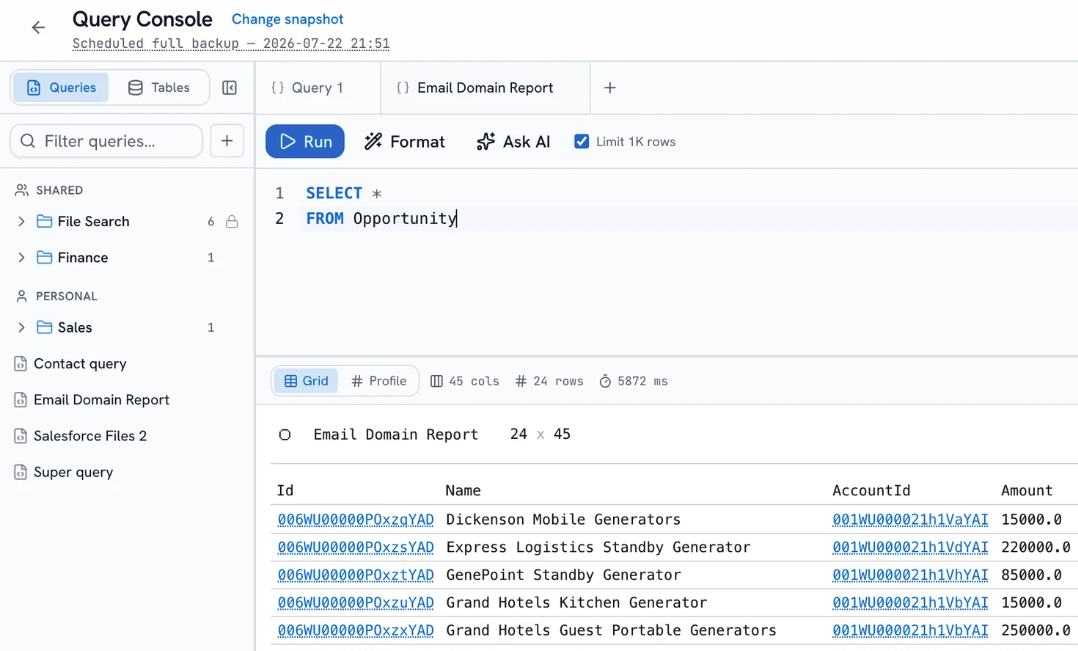
No API cost
The query runs against the snapshot, so the live org never sees it.
Any point in time
Point the console at last night's run, or one from six months ago.
Plain English works
Describe the question and the console writes the SQL for you.
Shared with the team
Saved queries live in a library, personal or shared with the org.
Straight answers
The questions a buyer actually asks when they are weighing these two, answered without hedging.
Want a demo? Book a demo
Should I just use Gearset?
If your main problem is releases, yes. Gearset's deployment and pipeline tooling is the core of its platform and bluefactory has no equivalent. Teams pick bluefactory when the snapshot itself is what they need to work with: query it, diff it, archive from it, seed from it, and keep it in their own cloud storage.
Can I run both?
Yes. Each connects to Salesforce over its own OAuth grant, and bluefactory writes to your storage rather than competing for anyone else's, so nothing conflicts. Keeping Gearset for deployments and bluefactory for the data layer is a reasonable setup.
Does bluefactory back up metadata the way Gearset does?
It captures the supported Salesforce metadata types in your tracker's scope, as a full snapshot on every build, with every captured change opened as a side-by-side diff and per-component history across builds. What it does not do is deploy metadata back into an org. The coverage page documents how the scope is derived and where it ends.
How often can bluefactory back up?
On the schedule you set, plus on-demand snapshots, as full runs or incremental base-plus-delta chains with a recurring full so a restore never replays unbounded history. Gearset documents hourly backups for critical objects. If a sub-daily recovery point is a hard requirement for you, raise it with us before you switch rather than after.
Where does my backup data live with bluefactory?
In your own Amazon S3, Azure Blob or Google Cloud bucket: your account, your region, your keys. bluefactory-managed storage is available if you would rather not run one. Encrypted at rest either way.
What happens to my backups if we stop paying?
If they are in your own bucket, they stay exactly where they are, in your cloud account. Cancelling bluefactory does not move or delete them.
How we compiled this
Every claim about another product on this page comes from that vendor's own public documentation, read on 8 August 2026. Products change, so check the current pages before you decide, and tell us if anything here is out of date. We will fix it.
Gearset and Salesforce are trademarks of their respective owners. bluefactory is not affiliated with, endorsed by, or sponsored by them.
Compare bluefactory with something else
bluefactory vs Salesforce
The Recycle Bin, the weekly export and the paid backup add-on, and where each one stops.
Read itbluefactory vs Odaseva
An enterprise compliance platform, next to one your team can start on by itself today.
Read itbluefactory vs GRAX
The closest thing to a shared premise: your data, your cloud. What each one gives you on top.
Read itSee it against your own org
Add an org and bluefactory takes the first snapshot on its own.
Free for one org, no credit card.